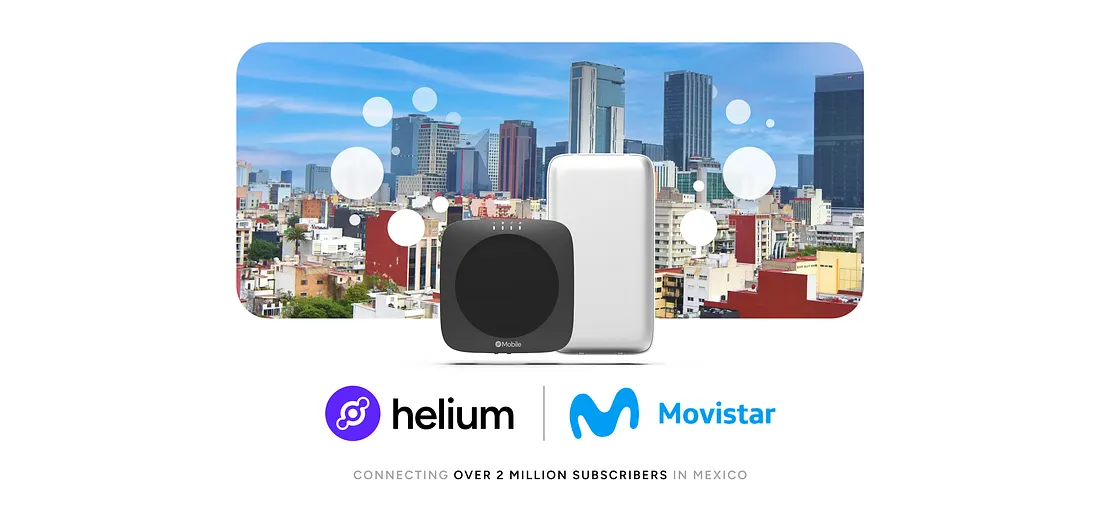
Hola, Mexico: Movistar is Bringing 2 Million Subscribers to the Helium Network
Movistar, Telefónica’s mobile flagship carrier in Mexico, and Helium have partnered to bring the Helium Network to 2.3 million subscribers in Mexico!
Movistar, Telefónica’s mobile flagship carrier in Mexico, and Helium have partnered to bring the Helium Network to 2.3 million subscribers in Mexico! Through this partnership, Movistar subscribers will be able to seamlessly connect their phones to the decentralized people-built network where it’s available, accelerating the mass adoption of the Helium Network across the country.
The Helium Network’s decentralized model provides wireless coverage differently than traditional cell towers. Helium relies on individual-owned Hotspots, which act as mini cell towers that can be set up in shops, venues, or businesses. The Hotspots provide coverage to nearby devices while rewarding owners with crypto for every byte of data their Hotspot transfers.
Pilot programs in 2024 proved the concept with Movistar customers: the carrier was able to offload mobile data traffic onto the Helium Network, and Movistar subscribers enjoyed seamless connectivity to the Helium Network.

Helium is quickly becoming a go-to solution for reliable, flexible connectivity, with its novel approach to deploying Hotspots and working with existing cell towers to offload data. And now, Movistar customers in Mexico can be part of this Network. Check out Movistar target sites in the Helium World Explorer here.
During the initial phase, Helium Mobile Hotspots can be purchased by emailing us at mexico@helium.com. In the coming months, it will be possible to purchase Hotspots on the Helium website and in Movistar retail stores and online channels.

As part of this collaboration, Movistar will also be able to resell Helium coverage to other local MVNOs (Mobile Virtual Network Operators), enabling others in the industry to utilize a network owned and operated by the people.
The Movistar and Helium partnership isn’t about deploying fancy new tech for the sake of it, or papering over the problem of increasing data demands. It’s about democratizing access to wireless coverage with a product that works:
More Hotspots mean more coverage, especially in areas where traditional towers don’t reach.
Decentralized networks reduce infrastructure costs, helping keep prices affordable.
Individuals who set up Hotspots earn crypto rewards, creating a win-win for businesses and consumers.
Together, Helium and Movistar are flipping traditional telco on its head with a bold new business model that leverages network infrastructure powered by individuals rather than centrally-operated cell towers. This model slashes overhead infrastructure costs for carriers like Movistar while improving coverage for consumers. As a major player in the telco industry, Movistar’s embrace of this model demonstrates the potential of decentralized wireless and puts Mexico at the forefront of cutting-edge technology.
“Helium is on a mission to make connectivity more affordable for the masses,” said Mario Di Dio, GM of Network at Helium. “Collaborating with Movistar amplifies our vision of decentralized connectivity, inviting millions of their subscribers to use the Helium Network.”